
Preaching and Ghana's Moving-Vehicle Ban: A Christian Perspective
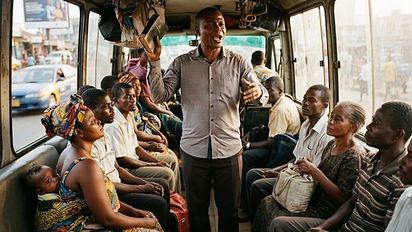
Reports circulating this week that Ghana has "banned preaching in buses" have spread faster. The reality is narrower, and it matters for how the Church responds.
What the law actually says
Ghana's Road Traffic Regulations, approved by Parliament in May 2026 (L.I. 2519), classify preaching or hawking inside a moving public or commercial vehicle as an offence. Preaching is not banned in buses as such: it is prohibited while the vehicle is in motion, and the rules now carry tougher penalties of up to eight months in prison or a fine of about $52, or both.
President John Dramani Mahama has since clarified the point directly: "We have not banned preaching in buses, only in moving ones." He explained that preachers may still share their message when a vehicle is stationary, but not while it is travelling. The Ghana Broadcasting Corporation and Graphic Online both carried the clarification, which was widely shared but often stripped of its context.
The restriction is not entirely new either. Ghana's Road Traffic Regulations of 2012 already prohibited causing a nuisance, including preaching and hawking, in a moving commercial vehicle. Enforcement was weak, and the practice remained common. What has changed in 2026 is the sharpened penalty and a more serious enforcement push.
The safety argument
Government officials frame the rule as a passenger-safety measure: a preacher moving through the aisle of a moving bus can distract the driver and increase risk in an already demanding traffic environment. Road safety authorities have long taken the position that commercial transport should carry passengers, not performances, while it is moving.
The evangelism question
Bus evangelism has been a familiar part of Ghanaian public life for decades, and for good reason. Boateng Bismark James, a 61-year-old pastor who has preached on buses leaving Accra's Neoplan station since 2023, told the BBC that some passengers say they first heard a Bible message through his preaching, not in church. Supporters see the practice as obedience to the Great Commission in a place where a captive audience would otherwise never hear it.
Critics within the Church are not hostile to evangelism itself; they raise questions of consent and method. A passenger bound for Kumasi cannot simply step off the bus. Bernice Nartey, a passenger on that route, told the BBC that preaching is welcome but should rest on the passengers' consent. That concern echoes a Christian conviction many believers share: the gospel is good news, not a public-address obligation, and a witness given under duress rarely sounds like good news to the listener.
What Scripture and wisdom suggest
Jesus instructed His disciples that where a message is not received, they should shake the dust off their feet and move on (Matthew 10:14). Paul modelled flexibility: reasoning in synagogues, speaking at riversides where people gathered to pray (Acts 16:13), and adapting to every audience for the sake of the gospel (1 Corinthians 9:22). None of these settings required a moving vehicle. The New Testament picture of evangelism is persuasive presence, not compulsory exposure.
Practically, the regulation leaves room for a vibrant ministry: preaching at stations before departure, conversations with consent on the journey, tracts handed out at terminals, and church-based transport evangelism that respects both the law and the listener. The gospel has never depended on a moving bus to travel.
A balanced view
Christians can hold two truths at once: the freedom to proclaim Christ is precious and should be defended, and road safety is a legitimate common good that governments are right to protect. The Ghanaian regulation targets neither faith nor churches; it regulates conduct on moving commercial transport. The Church's opportunity now is to model what it preaches, obeying the law (Romans 13:1) while finding fresh, consent-based ways to carry the message where people can freely receive it.
Sources: BBC News (Accra), Ghana Broadcasting Corporation, Graphic Online, Christian Daily.

About the author
Michael AdzatoMichael is the President and CEO of ChristianLens Media Inc., a global non-denominational ministry dedicated to advancing the Gospel through digital media. With a deep commitment to leveraging internet technology, he strives to reach and inspire millions worldwide. His passion for ministry is reflected in his writing, where he delivers timely news, articles, and stories that transcend denominational boundaries, providing insightful and faith-driven content to a diverse audience.
Comments (0)
More in Christian Persecution
Uttar Pradesh Authorities Arrest 10 Christians on Charges of Illegal Conversions
In a continuing crackdown on alleged illegal religious conversions, authorities in Uttar Pradesh, India, have arrested 10 Christians, including two pastors, during prayer meetings in private homes. The arrests were made following complaints from local villagers who accused the individuals of engaging in conversion activities. Uttar Pradesh, India’s most populous state, has been at the […]
Christian PersecutionThe Rising Tide of Religious Persecution: How Should Christians Respond?
Christianity is under attack. Across the world, believers face harassment, imprisonment and even death for their faith. According to Open Doors’ World Watch List 2024, more than 365 million Christians experience high levels of persecution (Open Doors, 2024). In nations such as North Korea and Afghanistan, following Christ can cost a person their life. Even […]
Christian PersecutionArrest of Christian Convert in Iran: Growing Concerns Over Religious Persecution
Somayeh Rajabi, a Christian convert from northern Iran, has been detained by IRGC intelligence agents since February 6, 2025. This arrest highlights the increasing pressure on Christians in Iran and ongoing concerns about religious persecution in the country. Background of the Arrest According to reports from human rights organizations, Rajabi was taken into custody in […]